
U.S. Law Routinely Discriminates Against Single People
Singlism: An Exponential Intersection of Disadvantage
This discrimination and bias against single people, also known as singlism, is insidious.[iv] Its power and danger lies in its subtlety. It permeates laws, economics, healthcare, business, entertainment, and news media. Moreover, when a society legally, financially, and commercially disenfranchises almost half its population, double harm is done to marginalized groups who are already impacted by other “isms” like racism, sexism, ableism, and ageism, creating an exponential intersection of disadvantage.
Individual Citizens Should Be the Basic Unit of Society
Technically, as U.S. citizens, single people already have all the rights listed in this Bill of Rights. The problem is that those rights are not being exercised, because U.S. law treats the nuclear family, rather than the individual, as the basis of society. This approach is outdated, because the (nuclear) family is no longer the basic unit of society. The basic unit of society is the individual citizen. In an individual’s lifetime, they have a variety of different relationships, and thus it makes sense to shape laws around the individual, rather than an arbitrary cross-section of one particular kind of relationship between individuals (whether romantic, sexual, parental, or otherwise). It’s time to change the procedural and legislative policies that reinforce this faulty cultural assumption. It’s time to prohibit discrimination based on all relationship statuses, including marital status. The Constitution currently has language protecting citizens from being discriminated against based on race, sex, gender, disability, or sexual orientation; it does not prohibit discrimination against single people and people in non-traditional and under-recognized relational lifestyles. It’s time to rewrite laws to recognize and respect a wider array of relationship choices and circumstances. This Singles Bill of Rights is intended as a thought paper and resource for people who are trying to understand and explain the extent of discrimination against single people and work towards dismantling it.
The Government Should Not Be Involved in Marriage
Although almost every adult is single for part of their life, U.S. laws and culture consider singlehood an incidental bookend to married life. This trope is outdated and amatonormative–a term coined by philosopher Elizabeth Brake, in her book Minimizing Marriage: Marriage, Morality, and the Law (OUP, 2012). Amatonormativity describes the idea that everyone aspires to, or should aspire to, a romantic coupled romantic relationship or marriage. Brake asks why the government is involved in marriage at all, and she asks if the legal benefits of marriage shouldn’t be available to friends as well.[v]
These are reasonable questions, given that in the U.S. alone, at least one in four young adults will likely never marry.[vi] Forty-two percent of U.S. adults are single and twenty-nine percent of households are comprised of one person, according to the 2023 Census.[vii] According to the Pew Research Center in 2020, half of single adults are not actively looking for a (romantic/coupled) relationship.[viii] The current U.S. and state governments, as well as the economic and public policies that are implicitly or explicitly supported by those governments, are not prepared for this huge demographic shift. The entire U.S. social/legal structure needs to adjust to the increasing number of single people.
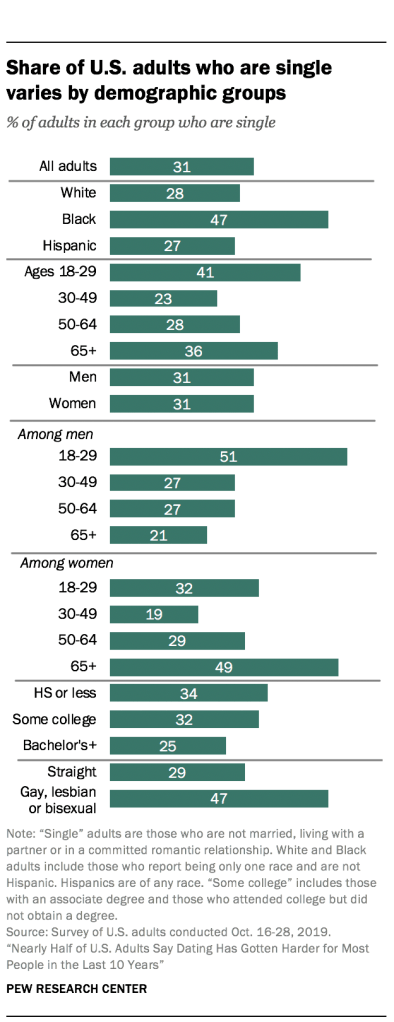
Marital status is a protected category under anti-discrimination legislation in less than half the U.S. states. Marital status is not on the list of protected characteristics under civil rights laws. (And even in those instances when states protect marital status, its aim is not to protect single people, but to protect married people from being discriminated against by employers because of their marital status.)
Goals of the Singles Bill of Rights
This Singles Bill of Rights and accompanying discussion document (henceforth SBR) explain the extent of singlism in the U.S. and propose actions that can be taken to eliminate this inequality and endow single people with the same rights as married people. The eventual mechanisms to achieving this are a suite of policies and legislative and regulatory requirements, accompanied by media campaigns to raise awareness and change social behaviour, and funding watchdog programs that keep our governments and businesses honest. The SBR lists specific rights where singles are currently shortchanged by government, law, and society. It elaborates on the nature of these rights and proposes some initial collective solutions for shifting away from the outdated paradigm of “married good, not-married bad.” It is intended to be a resource for single people and allies to educate themselves, loved ones, legislators, and other people in positions to effect change. It is intended to inform future policies and best practices. Because most of the specific rights denied to single people have to do with law and healthcare, the discussion document is divided into Legal/Financial and Healthcare sections. Singles are denied rights in other spheres as well, from business to academia to entertainment, but before and while singlism is routed in those areas, specific institutionalized legal and medical harms must be addressed. Therefore, the SBR also contains sections about collective solutions for ameliorating singlist policies.
The existence of anti-singles legislation essentially gives “permission” for politicians, corporations, and regressive demographics of the general public to continue perpetuating a deficit narrative of single people as lonely, lacking, and/or pathologized in some other way. In actuality, the 32 million people in the U.S. who live alone are more likely to attend public events, volunteer with civic organizations, and generally get out into society, according to Sociologist Eric Klinenberg, Director of the Institute for Public Knowledge at New York University and author of Going Solo: The Extraordinary Rise and Surprising Appeal of Living Alone (The Penguin Press, 2012).[ix] The single life has much to recommend it, and many single people enjoy their romantic relationship status. This doesn’t mean that they don’t need improved rights. No matter how much some single people may enjoy their status, as long as the deficit narrative exists surrounding single people, it allows politicians and corporations to create policies that harm single people.
The Executive Summary and its one-page list of rights on this website’s homepage summarizes the primary ways in which single people are disadvantaged because U.S. laws currently assume a basic unit of family, instead of an individual. A government has a social contract with individual citizens, not arbitrary groupings of citizens (historically nuclear families). Also on this website are discussion documents about the real-life impacts of these unfulfilled rights on single people’s legal, financial, and healthcare lives. Due to the ever-changing and far-reaching nature of the inequalities faced by single people, these documents will be living documents, subject to revision as necessary.
About Terminology: Most of the institutionalized discrimination flagged in the SBR is related to the legal statuses of married vs. unmarried—as opposed to the sociocultural statuses of someone who is romantically involved vs. someone who is socially single. Nonetheless, these prejudices overlap and such variables will need to be evaluated over time, as singles’ rights evolve. As policies are developed to eliminate discrimination against single people, it will be important to define and refine the meaning of “single” and recognize that singles are not a monolith, legally or sociologically. Some people are single by choice and some by circumstance. Some live alone, and some don’t. Some are romantically involved, and some aren’t. In this document, when we say “marital status” or “romantic relationship status,” we generally mean “marital or relationship status.” We decided to not use the term “relationship status” by itself, because “relationship” should be used to reference all human interactions, not just ones based in sex, marriage, or romance.
About Single People with Children: The SBR does not explicitly critique legislation and policies related to whether single or married people have children. While this important topic overlaps with many of the issues raised by the SBR, it is beyond the scope of this paper and requires a separate discussion document of its own. Suffice to say, any current or future legislation should also consider and preserve the rights of children, and the obligations of parents to care for them, within all the varieties of family frameworks.
Select either section below to continue reading:
[i] “Unmarried and Single Americans Week.” United States Census Bureau, Press Release Number: CB23-SFS.135, 17 September 2023, www.census.gov/newsroom/stories/unmarried-single-americans-week.html (Accessed: 20250310)
[ii] Arnold, Lisa and Christina Campbell. “The High Price of Being Single in America.” The Atlantic, 14 January 2013, www.theatlantic.com/sexes/archive/2013/01/the-high-price-of-being-single-in-america/267043 (Accessed: 20250310)
[iii] Davis, Maggie. Edited by Dan Shepard. “It Costs an Additional $297,674 to Raise a Child Over 18 Years, Up 25.3%.” Lendingtree.com, www.lendingtree.com/debt-consolidation/raising-a-child-study/ (Accessed: 20250429)
[iv] Morris, W. L., DePaulo, B. M., Hertel, J., & Taylor, L. C. (2008). Singlism—Another problem that has no name: Prejudice, stereotypes and discrimination against singles. In M. A. Morrison & T. G. Morrison (Eds.), The psychology of modern prejudice (pp. 165–194). Nova Science Publishers (Accessed 20250729)
[v] Brake, Elizabeth. “Minimizing Marriage.” ElizabethBrake.com, elizabethbrake.com/minimizing-marriage (Accessed: 20250310)
[vi] Wendy Wang and Kim Parker, 2014. “Record Share of Americans Have Never Married: As Values, Economics and Gender Patterns Change.” Washington, D.C.: Pew Research Center’s Social & Demographic Trends project, September, www.pewresearch.org/social-trends/wp-content/uploads/sites/3/2014/09/2014-09-24_Never-Married-Americans.pdf (Accessed: 20250310)
[vii] “Nearly Two-Thirds of U.S. Households are Family Households.” Press Release CB24-TPS-110, Census.gov, 12 November 2024, www.census.gov/newsroom/press-releases/2024/families-and-living-arrangements.html (Accessed: 20250503)
[viii] Brown, Anna. “A Profile of Single Americans.” Pew Research Center, 20 August 2020, www.pewresearch.org/social-trends/2020/08/20/a-profile-of-single-americans (Accessed: 20250503)
[ix] Klinenberg, Eric. Going Solo: The Extraordinary Rise and Surprising Appeal of Living Alone. New York: Penguin Press, 2012. Penguin Books.
Select either section below to continue reading:




 Singles Equality | Singles Bill of Rights